
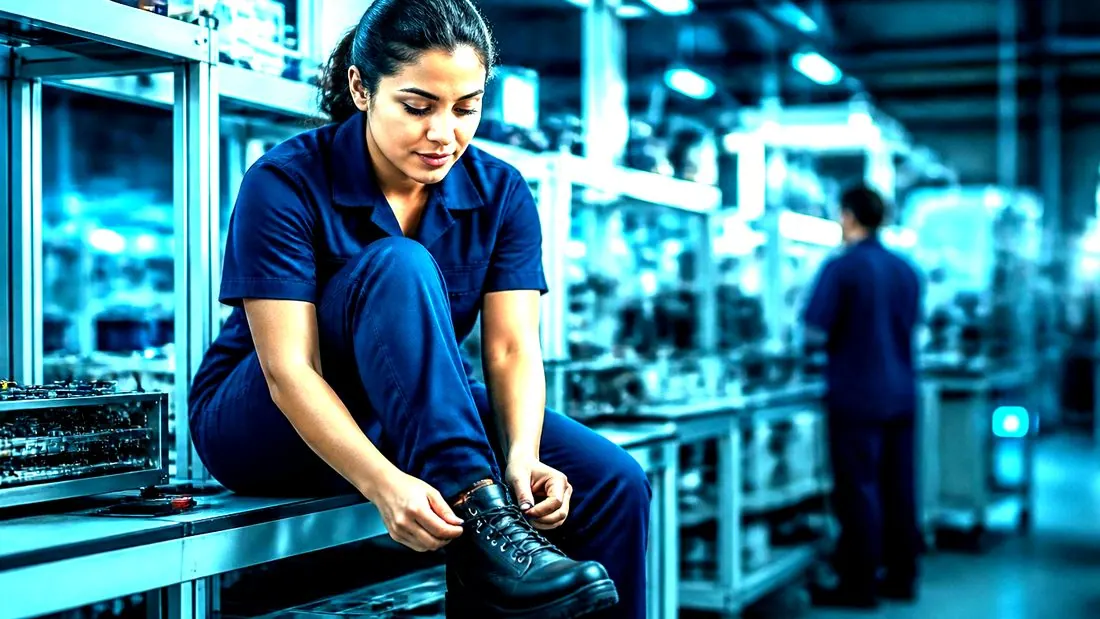
Women's Safety Footwear on a True Last, Not a Downsized Men's Fit
A true female last: narrow heel and wide forefoot. That is the difference between a pair worn all shift and one that ends up under the workbench.
In most Tijuana plants a large share of the assembly line is operated by women, and for years the only option was a men's model in a small size. It is not the same: the average female foot has a narrower heel and a proportionally wider forefoot.
The result of wearing the wrong last is not a complaint, it is a statistic: heel blisters from slippage, metatarsal pressure, and a pair that within three weeks is stored under the workbench while the operator comes in wearing sneakers.
We carry protective footwear on a true women's last, with the same toe cap and sole performance as the men's line. Sizing is taken the same way: with a measuring device, on site and by name.
What to check in this line
Narrower heel
Eliminates the slippage that causes counter blisters, the number-one injury of badly fitted footwear.
Proportionally wider forefoot
The cap covers without squeezing the metatarsals, which get compressed in a downsized men's last.
Same level of protection
Polycarbonate cap and dielectric sole identical to the men's line. Different last, equal protection.
Lower weight
Because the whole last is scaled rather than just the length, the pair weighs less and shift fatigue drops measurably.
Where it is used
- Electronics assembly lines
- Medical device and clean rooms
- Quality inspection and metrology
- Warehouse and inventory control
- Food processing
- Supervision and floor walks
About women's safety footwear

Need to equip your plant?
Tell us which position needs protection and how many people. We reply with datasheets, an itemized price and a firm delivery date.